
Myanmar (Burma) now has a an anticorruption law. The Hluttaw passed the Corruption Eradication Law this week for the first time requiring senior government officials – including judges, legislators, and the president – to declare their assets. The law itself is not yet available in English. In the meantime, The Irrawaddy has more details here.
Category Archives: Burma
Anti-Corruption Law (Myanmar/Burma)
Comments Off on Anti-Corruption Law (Myanmar/Burma)
Filed under Burma, corruption, Myanmar
Blaming the victim: (Myanmar/Burma)
Sadly, I’m starting to wonder if I should start a new section called “blame the victim” on Rule by Hukum. This week, two more Muslims have been arrested in connection to the communal riots in Okkan, near Yangon. One of the Muslim women allegedly accidentally bumped into a Buddhist monk, while another woman yelled at the monk for lying about the incident. The incident then caused a riot in which Muslim property was burned.
Of course, what happened to the monk is unfortunate. But the rioting against Muslims has gotten out of hand. Even more worrying has been the ineffective government response. According to The Irrawaddy, “Burma has seen clashes between Buddhists and Muslims in several states this year, but so far only Muslims have been imprisoned.” This year, the government has convicted more than 10 Muslims but no Buddhists.
At Wilson Center event in D.C., Pyithu Hluttaw Speaker Shwe Mann recently reminded the audience that the 2008 Constitution bans religious discrimination. One can only hope the government finds a way to put that sentiment into practice.
Comments Off on Blaming the victim: (Myanmar/Burma)
Filed under Burma, courts, human rights, Myanmar, religion
Myanmar Supreme Court website! (Myanmar/Burma)
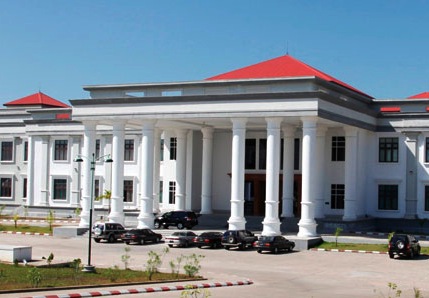 Myanmar’s Supreme Court has just created a website. It’s a slick design and already contains the 2011 Myanmar Law Reports and a recent volume of the Judicial Journal. Definitely worth bookmarking.
Comments Off on Myanmar Supreme Court website! (Myanmar/Burma)
Filed under Burma, Myanmar, Supreme Court
Is ATCA dead? (Myanmar/Burma)
I have published a short review of John T. Dale’s Free Burma in the Journal of World-Systems Research. Dale’s book explores the implications of transnational human rights litigation, focusing on the case that Burmese rights groups filed against UNOCAL under the Alien Tort Claims Act (ATCA).
One of my questions about the book is whether ATCA suits represent a viable tool for human rights advocates. According to the U.S. Supreme Court, probably not. In Kiobel v. Royal Dutch Petroleum Co., the majority, led by Chief Justice Roberts, declared that there should be a “presumption against extraterritoriality” in the application of the law. While this doesn’t bar future ATCA suits – and EarthRights notes the decision does not bar all ATCA suits against corporations – it certainly will discourage lower court judges from admitting them.
Comments Off on Is ATCA dead? (Myanmar/Burma)
Filed under ATCA, Burma, human rights, Myanmar
Does Rule of Law matter? (Myanmar/Burma)
On the pages of the Democratic Voice of Burma website, Elliott-Prasse Freeman and Ellen Wiles have been debating the importance of the rule of law for Myanmar’s political transition. This of course is a significant debate and political scientists have debated it for years. I won’t try to summarize the literature comprehensively, but I thought I’d provide some examples.
A traditional view of the relationship between the “rule of law” and economic growth is that independent courts provide businessmen and investors with a “credible commitment”that the government will respect contracts and private property . Rafael LaPorta, Florencio Lopez-de-Silanes, and Andrei Shleifer, have written several articles arguing that judicial independence, common law legal systems, and “rule of law” tend to increase economic growth. Stefan Voigt likewise finds that judicial independence and accountability tend to improve growth.
By contrast, the relationship is much murkier when looking at human rights. Sandholtz finds that human rights treaties are more effective in countries with independent courts. However, Volcansek and Lockhart find no relationship between judicial independence and human rights conditions more broadly. Law and Veerstag are also generally skeptical about the effect of constitutional provisions protecting rights to have an effect in practice.
However, three problems plague this literature. First, there is what political scientists call “reverse causality” whereby the dependent variable (economic growth) also impacts levels of “rule of law.” Second, there is an “omitted variable bias” whereby there might be some third variable that influences both levels of “rule of law” and the economy. Finally, as Ellen Wiles noted in her DVB piece, measuring judicial independence and the “rule of law” are frustratingly difficult.
By contrast, in the literature considering the origins of judicial independence, many scholars argue that political elites only create independent courts when they are politically constrained. Independent courts protect elites if and when they fall from power (Tom Ginsburg’s Judicial Review in New Democracies is probably the best known work in this field). A paper by several of my co-authors at the University of Michigan finds that the distinction between authoritarian and democracy isn’t so relevant for promoting economic growth and public goods. Rather, the key difference is political constraints on rulers.
Indeed, what we’re currently seeing in Myanmar now is the development of very real political constrains on the government. Gone are the days of one-general rule. Neither President Thein Sein nor Speaker Shwe Mann (nor Commander in Chief Min Aung Hlaing for that matter) can make policy unilaterally on most subjects. It’s probably not a coincidence that constitutional reform and judicial reform are now on the table (although it’s too early to tell how far they will go).
While the debate in the literature is far from settled, my sense is that the “rule of law” and independent courts might provide Myanmar with a more hospitable economic climate, but most businesses (especially foreign investors) will be more concerned about the basics, such as real estate, internet, infrastructure, etc. However, broader “rule of law” and judicial reforms do seem to stem from political changes at the top, so it might be a mistake to hope that the “rule of law” could lead to democracy or human rights.
 Dominic J. Nardi, Jr.
You must be logged in to post a comment.